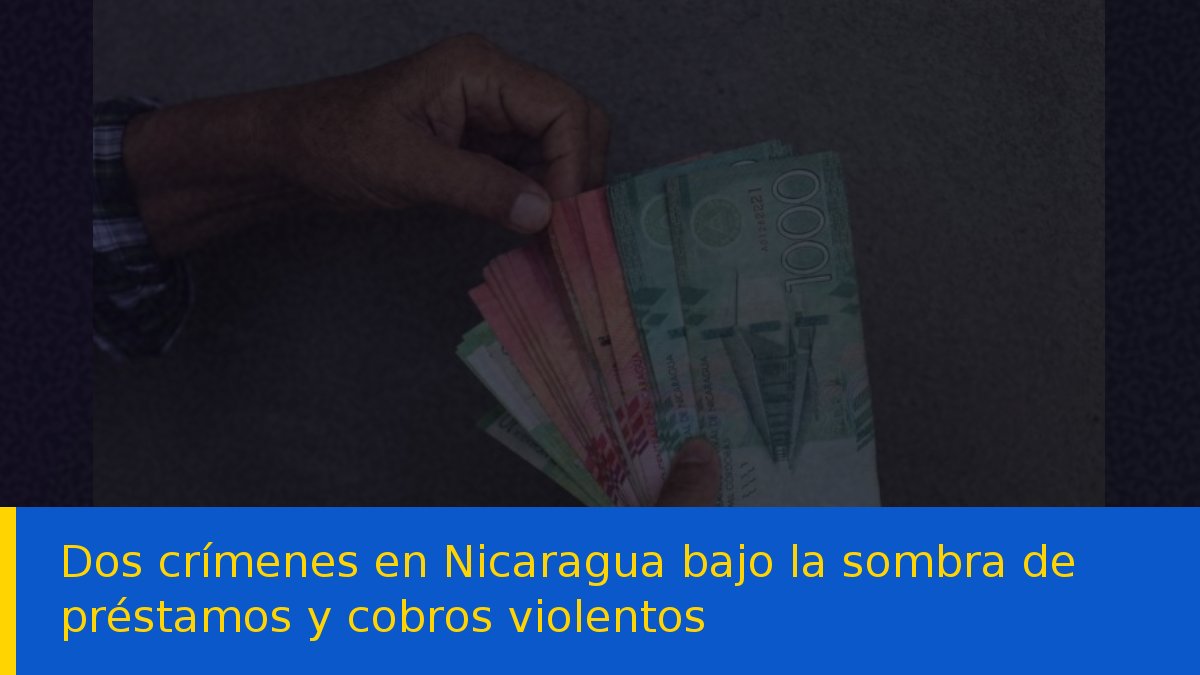
Two killings in different parts of Nicaragua have been tied, according to press accounts, to debts owed to money lenders and to collection practices that allegedly escalated into threats and violence. The cases involve Santos Hernández Centeno, murdered in Wiwilí, Jinotega, and Franklin Lampín, killed in Nagarote along with his partner.
- Santos Hernández Centeno: aged 59, he died on Sunday, July 26, 2026, inside his home in the La Esperanza hamlet of Wiwilí, and months later the case remained unsolved.
- Debt under suspicion: local accounts link the killing to an obligation of just over 100,000 córdobas (about USD 2,710) owed to a presumed creditor known only by the surname Galindo.
- Franklin Lampín: a money lender in Nagarote, he was murdered on August 28 together with his girlfriend, Yeymi Solórzano; prosecutors charged two men who confessed, and the attributed motive was a USD 750,000 debt.
The Wiwilí killing and the hundred-thousand-córdoba debt
According to the account reported in the press, two armed men entered Hernández's house while he was alone. A neighbor said the attackers carried a shotgun and went straight for the victim.
“Iban con escopeta y ya iban directo a dispararle. No le dio ni chance de correr al compadre”, the neighbor recounted.
The testimony indicates the men beat Hernández and struggled with him. The victim tried to flee; one attacker shot him and, when he fell wounded to the ground, the other beheaded him with a machete.
Hernández's sister-in-law, Aracely Lago Cárdenas, was reportedly the only witness to the event and, according to pro-government media, testified to the police about what happened. People in the area said the homicide might be connected to a debt of just over 100,000 córdobas (USD 2,710) owed to a man identified only by the surname Galindo.
Information attributed to police investigations indicates Hernández had received warnings over that debt but was unable to pay it off. A resident described Galindo as someone with contacts in the area who lent money to other people, a version that does not establish his full identity or whether he took direct part in the killing. The victim's widow did not respond to attempts to contact her, and there was no public information about suspects or arrests linked to the file.
Nagarote: arrests, a confession and a USD 750,000 motive
The Lampín case differs because there were arrests and a Prosecutor's Office charge. Lampín, a money lender in Nagarote, was killed on August 28 along with his girlfriend, Yeymi Solórzano.
The Public Ministry charged Ernesto Agustín Cruz Baltodano, 38, and Luis Alexander Contreras Lampín, 24 and a cousin of the victim. According to the available information, both eventually confessed to the crime.
The charge held that the two men threatened Lampín and Solórzano with firearms, seized control of the pickup truck they were in and took them to a dirt road in Peña Ventosa. There, Lampín was shot point-blank in the head, while Solórzano was shot in the chest and in the forehead.
According to prosecutors, the perpetrators placed the bodies inside the truck and left a weapon behind to make it appear that Lampín had killed his partner and then himself. The Public Ministry also charged Yimin Maycol Bravo Santana and Luis Carlos Zapata, who allegedly fled to Costa Rica.
The attributed motive was a USD 750,000 debt that Lampín failed to pay within a one-month deadline reportedly imposed on him. The Prosecutor's Office said Luis Alexander Contreras Lampín lived for several years in Costa Rica before returning to Nicaragua in 2025, and that he had ties to organized crime groups and allegedly worked as a hitman in that country.
The “gota a gota” phenomenon and the statistical void
Loans known as “gota a gota” are informal credits usually collected through daily or frequent installments. Their origin is associated with Colombia and with the expansion of lenders from cities such as Medellín to other Latin American countries. This type of credit targets small merchants, informal workers, street vendors and people who need cash without meeting banking requirements.
Interest rates can reach 10%, 20% or even more than 30% monthly, depending on the country and the network. Late payments can trigger surcharges, intimidation, threats against relatives and physical attacks. However, not all informal loans or “gota a gota” schemes are linked to criminal activity: the existence of a high-interest loan, by itself, does not prove a crime was committed.
In Nicaragua, Law 176 regulates loans between private individuals, and article 263 of the Criminal Code sets penalties of one to four years in prison for usury, with possible increases for habitual lenders.
A security analyst consulted on condition of anonymity considered that structures may exist that specialize in lending at high interest and pressuring those who fall behind. In his assessment, some collectors increase the amount owed until it becomes a figure difficult to cover and then resort to intimidation.
“Así va incrementando la deuda, hasta que se vuelve una suma atractiva para el delincuente y comienzan a usar la intimidación y después la violencia”, the specialist said.
The expert mentioned threats against relatives and the seizure of valuables as supposed collateral, and warned that in the most serious cases the violence can lead to homicides. He also noted that the absence of official statistics makes it impossible to know whether the phenomenon grew, declined or remained stable over the past five or six years, and questioned police conduct in these cases. That assessment belongs to the interviewed source; the available material contains no police response to those claims.
The two cases expose a gap in official information: without systematic data or police resolutions in episodes such as Hernández's, it is difficult to gauge the real scale of informal lending networks and to establish responsibility. The contrast with the Nagarote file, where there were arrests and confessions, underscores how important judicial clarification is to distinguish between informal credit and structures that use violence as a collection method.