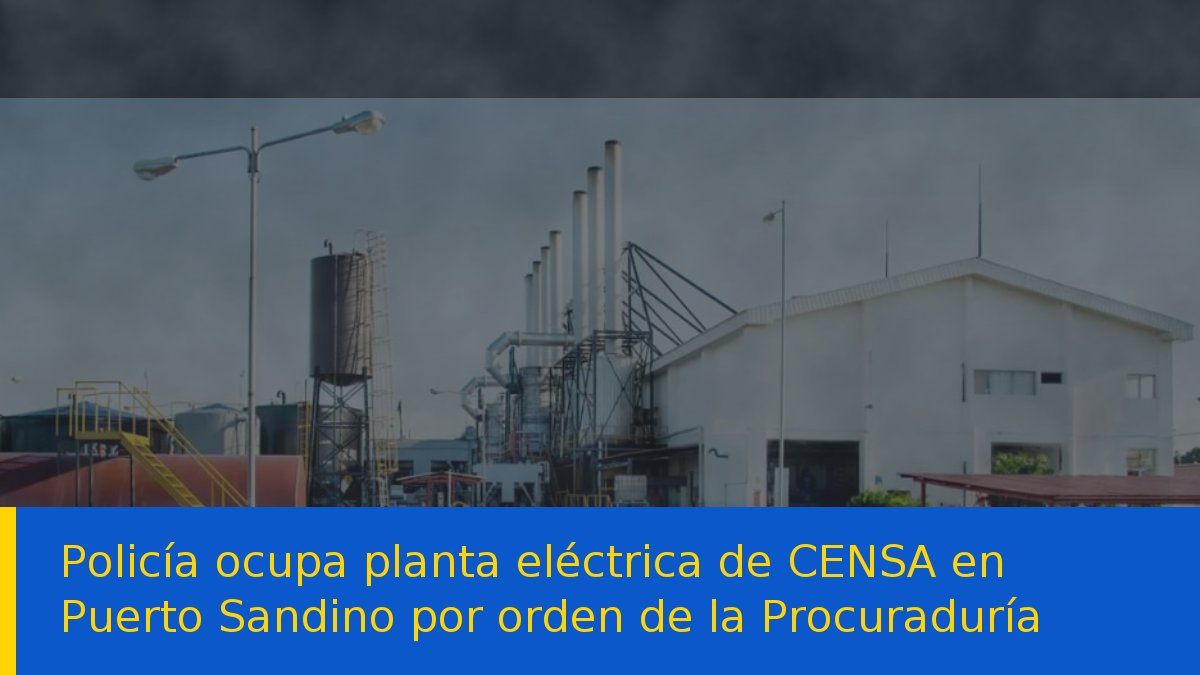
Police officers took over the facilities of Corporación Eléctrica Nicaragüense, SA (CENSA), a power generator tied to businessman Joaquín Cuadra Lacayo, in Puerto Sandino, León, according to business-sector sources consulted by Confidencial.digital. The operation was carried out on instructions from officials of the Procuraduría General de Justicia, the sources said. Neither state institutions nor Cuadra Lacayo and his partners had publicly confirmed the intervention or responded to phone requests for comment.
- Takeover: The Policía Nacional occupied CENSA's installations in Puerto Sandino, León, acting under orders from the Procuraduría General de Justicia, per business sources.
- Ownership link: CENSA is associated with Joaquín Cuadra Lacayo, a retired general and former head of the Nicaraguan Army, who did not answer requests for comment.
- Power capacity: The plant has operated since 1997, holds 57 MW of installed capacity, and maintains a bunker fuel reserve exceeding 645,000 gallons.
- Political suspicion: A business source said the technical and financial explanations could mask a political motive, an interpretation not confirmed by authorities or the company.
A key player in the national grid
CENSA operates at kilometer 68 on the road to El Velero and has been part of Nicaragua's electricity system since 1997. The Centro Nacional de Despacho de Carga keeps its generation registered within the national interconnected system and records a fuel reserve above 645,000 gallons of bunker at the plant.
The company began producing electricity in May 1997 with nine units, each rated at four MW, for an initial capacity of 36 MW. In October 2000 it added four units of seven MW each, raising installed capacity to 57 MW. On its website, the firm describes itself as a participant in Nicaragua's energy sector.
Official allegations and the private-sector account
According to information gathered by Confidencial.digital, authorities would have cited alleged breaches of the electricity supply contract, along with supposed arrears to the Instituto Nicaragüense de Seguridad Social and the Dirección General de Ingresos.
A business source, however, maintained that the technical and financial justifications could conceal a political reason. That view was not confirmed by state authorities or company representatives, who also did not respond to telephone requests for their position.
“El pecado de fondo es político”, the source told the outlet. The person suggested that any delays or debts might be treated differently if Cuadra Lacayo and his partners were aligned with those in power.
The information attributed to the business source does not include a response from CENSA regarding the allegations about the supply contract, the Instituto Nicaragüense de Seguridad Social, or the Dirección General de Ingresos.
A pattern of business interventions
The action against CENSA came after Rocedes, another firm linked to Cuadra Lacayo, was subjected to a similar measure. That company operates under the free-zone regime in the Parque Industrial Las Mercedes in Managua.
The case adds to precedents of companies pressured by state collection agencies and of interventions in mining or recycling firms later handed to Chinese competitors, according to the cited report.
The U.S. State Department has warned for years that anyone considering investing in Nicaragua should act with “extrema precaución” given the country's levels of legal insecurity.
The takeover of CENSA deepens uncertainty surrounding the energy sector and private investment in Nicaragua, where administrative interventions against firms tied to figures critical of the government have multiplied. Official silence on the reasons for the measure, and the company's lack of response, leave open questions about the operational future of a plant that supplies 57 MW to the national grid and about legal guarantees for investors in the country.