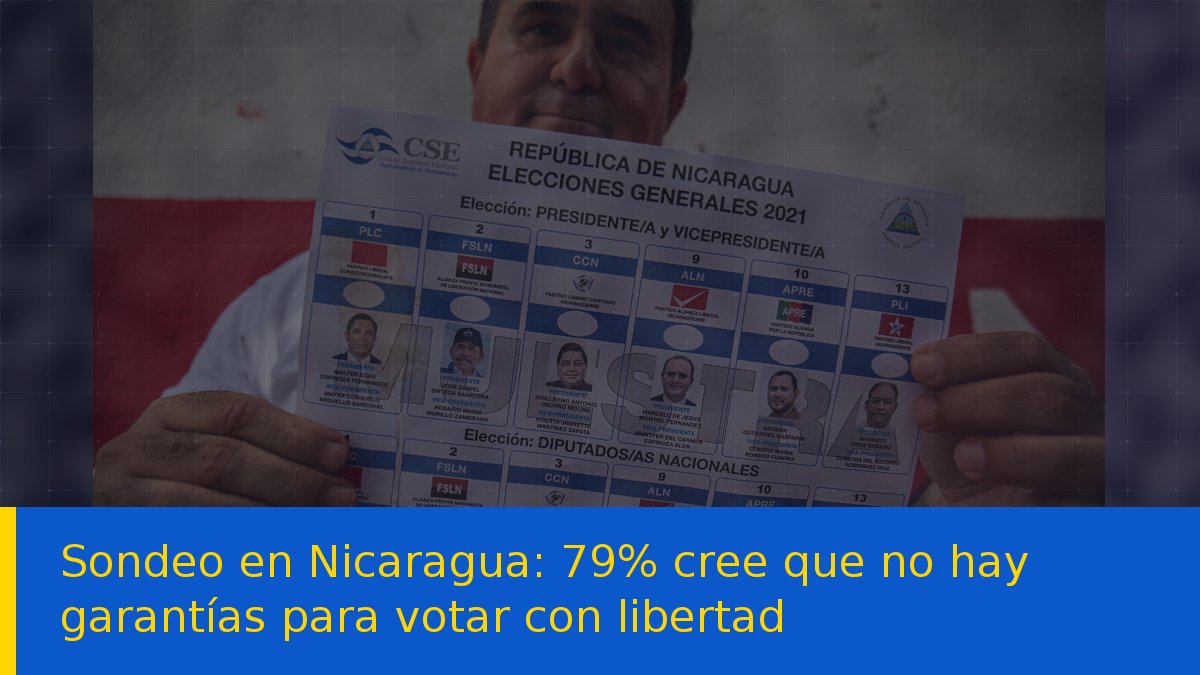
A September citizen consultation by Hagamos Democracia NIC-CR found that 79% of respondents believe Nicaragua currently lacks the conditions for free, competitive and observable elections. The study gathered 400 valid responses across 40 territorial units, including Managua districts.
- Widespread doubt: 316 of 400 respondents said there are no guarantees for a transparent vote; only 31 (7.8%) said yes, while 53 (13.2%) did not know or did not answer.
- Public freedoms first: restoring public liberties was the most cited condition, with 216 mentions (54%).
- Other demands: free participation of opposition parties and movements and a reform of the Supreme Electoral Council (CSE) each received 209 mentions (52.2%), followed by independent electoral observation with 206 (51.5%).
- Postponement scenario: in a segment of 302 people, 80.1% linked a possible extension of terms and delay of elections until 2028 to a deterioration in the ability to choose freely.
Guarantees respondents demand
When asked which conditions must be met for elections with competition and checks, participants ranked restoration of public freedoms first, cited by 216 people, or 54% of the sample.
Free participation of opposition parties and movements and a reform of the Supreme Electoral Council (CSE) tied for second, with 209 mentions each (52.2%). Independent electoral observation followed closely with 206 responses (51.5%).
The list also included the release of political prisoners, named by 177 people (44.2%), and the need for a transparent electoral registry, mentioned by 139 participants (34.8%). Because it was a multiple-choice question, each respondent could select more than one condition.
Concern over a possible electoral delay
The report also surveyed a group of 302 people who said they perceived surveillance or control in their environment, regarding a scenario in which elected authorities' terms are extended and general elections postponed until 2028.
In that segment, 177 respondents (58.6%) said such an event would greatly reduce the possibility of choosing freely. Another 65 (21.5%) said it would reduce it somewhat. Overall, 80.1% associated a possible electoral postponement with a deterioration in electoral choice.
Among the most cited consequences, 40.4% anticipated greater concentration of power. 24.5% said international pressure could grow, while 23.8% linked that scenario to greater citizen demobilization or hopelessness. The document clarifies that these are assessments of a hypothetical posed in the questionnaire, not verified predictions.
Low political participation and a climate of surveillance
The consultation also recorded low participation in political, social or party movements. Only 52 of the 400 respondents (13%) said they take part in such groups. Among the 282 who said they do not participate, 145 said they could or might do so.
The report avoids attributing this gap between interest and participation to a specific cause. However, it links electoral demands to a context in which 80.7% of substantive responses indicated having detected surveillance or control in their environment. For consultation participants, guarantees for voting also depend on the ability to express oneself, organize and act politically without fear of reprisals.
The study used a descriptive, non-probabilistic design, so its results reflect the opinions of those who participated and cannot be extrapolated to the entire Nicaraguan population. Despite that methodological limitation, the document offers a map of citizen perceptions about the electoral process and the conditions that, according to respondents, would be indispensable to restore confidence in the ballot box.