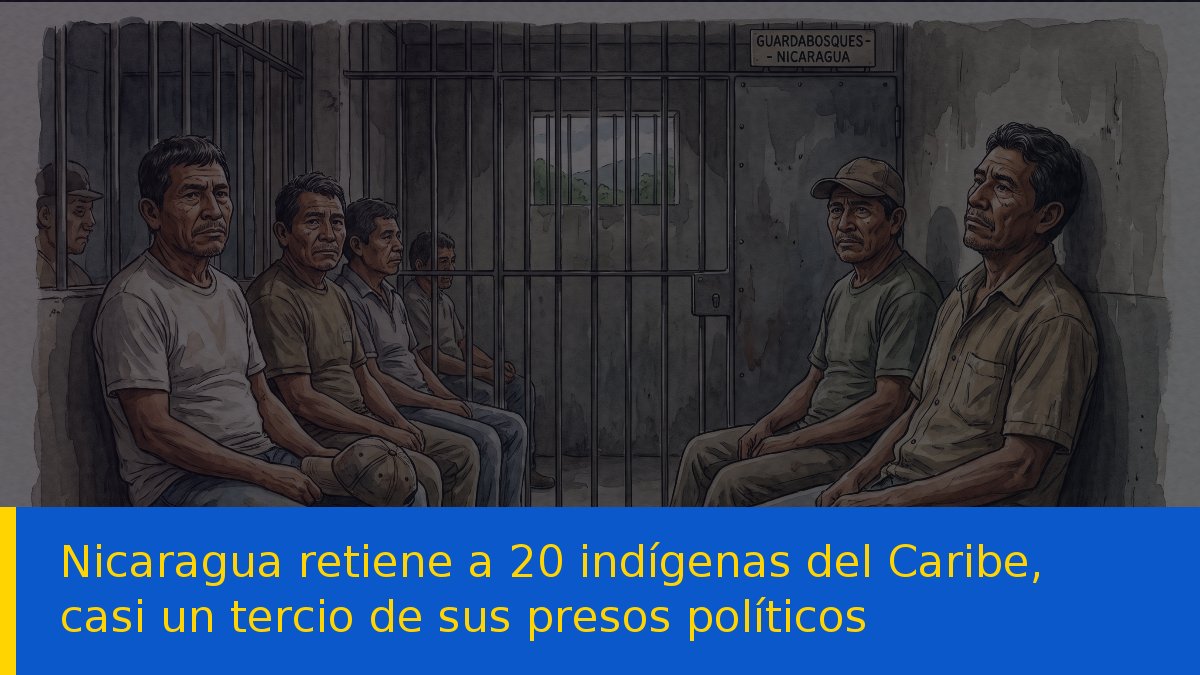
Twenty people from the Caribbean Coast make up nearly 28 percent of the political prisoners recorded in Nicaragua, according to the latest update through October 23 by the Mechanism for the Recognition of Political Prisoners. The list includes community authorities, park rangers and territorial defenders, accounting for 27.8% of the 72 individuals registered as political prisoners. Indigenous organizations link these arrests to disputes over communal lands, natural resources and regional autonomy.
- High proportion: the 20 indigenous people represent almost a third of all registered political prisoners.
- Territorial concentration: 11 of the detainees belong to the Mayangna Sauni As territory, located in the Bosawas Biosphere Reserve.
- Context of conflict: organizations connect the detentions to conflicts over communal lands, natural resources and autonomy.
Detentions and silence in the Caribbean Coast
The Group for Reflection of Released Political Prisoners (GREX) reported that 11 of those imprisoned are from the Mayangna Sauni As territory, within the Bosawas Biosphere Reserve. The organization added that at least two additional cases are not in the public registry because their families chose to remain silent. According to GREX, this situation encourages communities to refrain from denouncing land invasions and dispossession.
GREX stated that pressure on indigenous communities goes beyond detentions, aiming to restrict their ability to claim collective rights and question activities affecting their territories.
“The high number of prisoners from the Caribbean shows the offensive to dismantle and exert social control over indigenous populations of the Caribbean Coast,” GREX said, as reported by Diario La Prensa.
Dispute over land, resources and autonomy
The Observatory of Indigenous and Afro-descendant Peoples (OPIA) described the repression in the Caribbean Coast as part of a historical dispute over political control of the area, its lands, natural resources and autonomous governance. The body noted that a centralist vision has treated the region as a space available for exploitation, without recognizing the historical rights of its inhabitants or the existence of communal lands and their own authorities.
Extractive activities and economic interests in these territories, OPIA indicated, have deepened conflicts with communities defending their rights against invasions of indigenous lands. The entity stressed that there is no single profile among those persecuted: arrests target those involved in territorial protection, community positions or denouncing harm to communal properties.
“We find park rangers, communal authorities, territorial defenders and even a presidential advisor,” OPIA said, referring to the case of Steadman Fagoth, detained after denouncing invasions of indigenous lands while holding that position.
For the observatory, this case shows that persecution goes beyond party militancy and reaches those carrying out environmental protection, territorial defense or community representation.
Weakening of indigenous political representation
OPIA also linked the situation to the weakening of independent indigenous political organization in the Caribbean Coast. It recalled the region's history of resistance to decisions imposed by central power and mentioned Yatama as one of the political expressions with the greatest convening and electoral capacity in the region for decades.
The cancellation of that organization and the imprisonment of its leaders, according to the observatory, reduced the spaces for political representation of indigenous peoples. An OPIA director considered that the situation affects the possibility for communities to participate in decisions about their lands, resources and the exercise of regional autonomy.
The body warned that the rights of indigenous and Afro-descendant peoples lose effectiveness when there are no conditions for communities to manage their territories and decide on their resources without pressure.
The case of Brooklyn Rivera and registry figures
GREX expressed concern over the situation of seven relatives and associates of Miskito indigenous leader Brooklyn Rivera, who died in custody. These individuals were arrested while trying to claim his body, according to the organization's analysis.
The group considered that the detentions served as a warning to Miskito populations and reinforced silence regarding abuses denounced in the region. OPIA stated that preventing Rivera from being mourned and buried in his territory affected both his family and the collective memory of the Miskito people, given his trajectory in the autonomy movement.
The mechanism's update recorded 33 people as forcibly disappeared, with no verifiable official information about their whereabouts or the circumstances of their detention. The registry also includes 16 older adults, eight of whom remain missing, and two minors among those imprisoned for political reasons.
The mechanism warned about serious illnesses, restrictions on access to medical care, spoiled food, unsafe drinking water, isolation and punishments in detention centers. It demanded the immediate release of all political prisoners, proof of life for those still missing and measures to protect their health and integrity.
The document clarifies that the registry corresponds to cases that could be identified, so it does not establish that the list reflects the totality of detentions for political reasons in Nicaragua. The persistence of these figures, in a context of dispute over communal lands and autonomy, maintains pressure on indigenous communities of the Caribbean Coast and poses a challenge for regional political representation in the coming months.