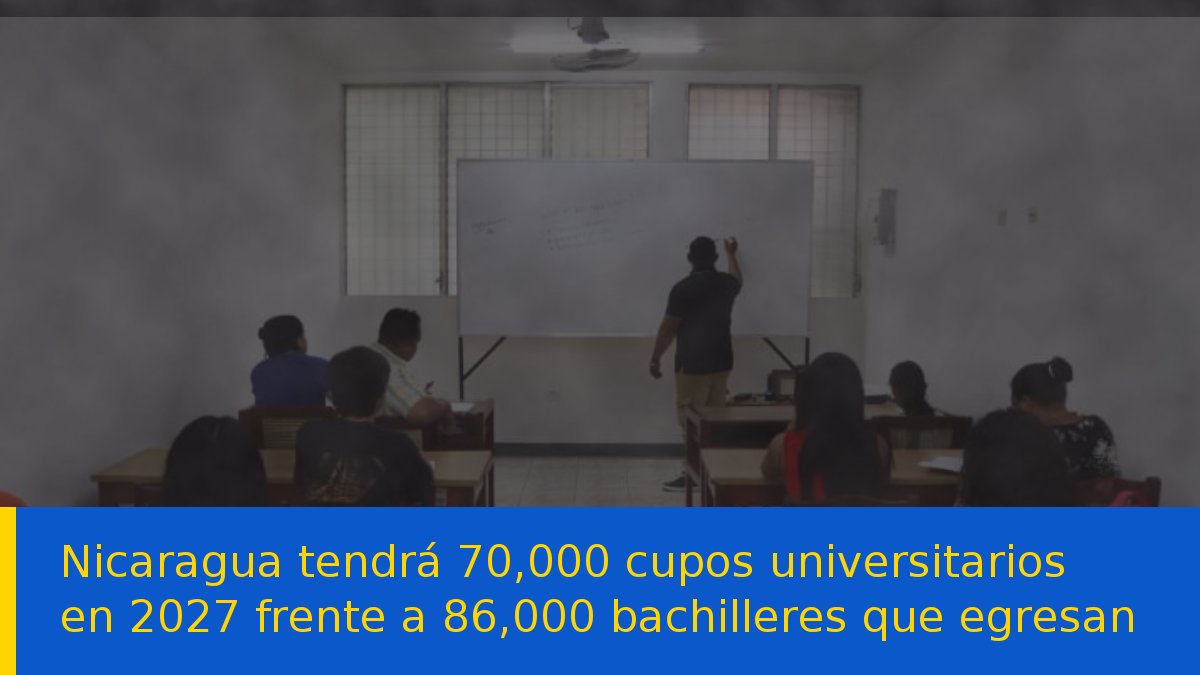
Nicaragua's public universities will offer 70,000 places for the 2027 academic year across 130 degree programs and 13 study centers. That total is lower than the allocation for 2026, even as 86,000 students from public and private high schools are set to finish their secondary studies this year.
- Key Point: The 2027 offer of 70,000 spots in 130 programs at 13 centers falls below the 2026 allocation.
- Key Point: Some 86,000 high school graduates will emerge this year, exceeding the available university places.
- Key Point: Online pre-registration runs until November 19, 2026, and the system does not include entrance exams.
- Key Point: Five new programs will be added in 2027, but officials did not specify which ones or how many places each will receive.
Demand outpaces the planned offer
The Technical Secretariat for University Attention said five degree programs will be incorporated in 2027, though it did not identify them or say how places will be divided among institutions and programs. The university network includes the Universidad de Emprendedores La Sandino, created in 2025 on a confiscated property; it has no graduating classes yet and no consolidated plan for its programs is known.
For 2026, the National Autonomous University of Nicaragua in Managua offered 14,000 places, and new enrollment figures for the remaining universities have not been released so far, according to Confidencial.digital.
How admission works
Pre-registration will be available until November 19, 2026 through a single online admission platform. The system does not include entrance exams. Each applicant may choose three alternatives across universities, campuses and modalities.
The call is aimed at students in their final year of secondary school, high school graduates with no prior studies at public universities, people seeking to change majors and those who want to begin a second course of study. The SECET excludes those who completed a degree but have not yet processed their diploma, as well as students suspended temporarily or permanently for disciplinary reasons.
Applicants must use the unique code from their identity card or birth certificate to complete registration. Ordinary enrollment had 51,687 registrants during the first two weeks of the call.
Bismarck Santana, technical secretary for university attention in Nicaragua, told a pro-government outlet that registration had reached 53,687 applicants. Of the total, 38% were under 19 years old.
The official said 11,938 students were in the 20-to-29 age group, while another 1,941 applicants were over 30. The remaining 2,000 registrations corresponded to the open online university and applicants from the National Penitentiary System.
Grades, not exams, determine placement
Public universities stopped applying admission tests in 2020. Since then, places have been distributed according to students' grade averages over their last two years of high school. The process considers grades in Mathematics, Language and Literature, Biology, Physics and English, and programs assign their places first to applicants with the highest marks.
When an option reaches its limit, applicants move on to compete for their second preference. If they are not admitted there either, the system evaluates their third choice.
Enrollment and faculty under scrutiny
The SECET maintains that national university enrollment exceeds 200,000 students in 2026, an increase of 46% compared with the 137,162 students counted in 2021. The latest statistical yearbook from the National Council of Universities, with data through 2023, put enrollment at around 193,116 students and recorded 9,519 faculty members.
That report also noted that 28% of professors held a master's degree and 5% had earned a doctorate. In addition, only 30% of the nearly nine thousand faculty members had a permanent position.
With a gap of at least 16,000 places between graduates and available spots, the 2027 process will test the public system's capacity to absorb demand. The lack of details on the new programs and on how places will be distributed by institution leaves open questions about how competition among applicants will play out and how much weight high school averages will carry in a model that no longer uses entrance exams.